Week 1 Art History Review
Art is an evolutionary and technological marvel. The earliest humans created art from nothing - having first to create the tools and concept of representation itself. The podcast “A History of the World in 100 Objects” episodes included in this week’s listening explored two of the oldest objects in the collection at the British Museum.
Art is an evolutionary and technological marvel. The earliest humans created art from nothing - having first to create the tools and concept of representation itself. The podcast “A History of the World in 100 Objects” episodes included in this week’s listening explored two of the oldest objects in the collection at the British Museum. Both found in the Olduvai Gorge in Tanzania, the chopping tool and hand axe are early examples of humans shaping the world around them to perform a task. Without sharp teeth or claws to aid them, early humans saw the need to create a cutting implement. Here is the origin of art. It is found in the notion that “creation” is something a human is capable of doing. These tools are what allowed early humans to flourish and spread outside of Africa.
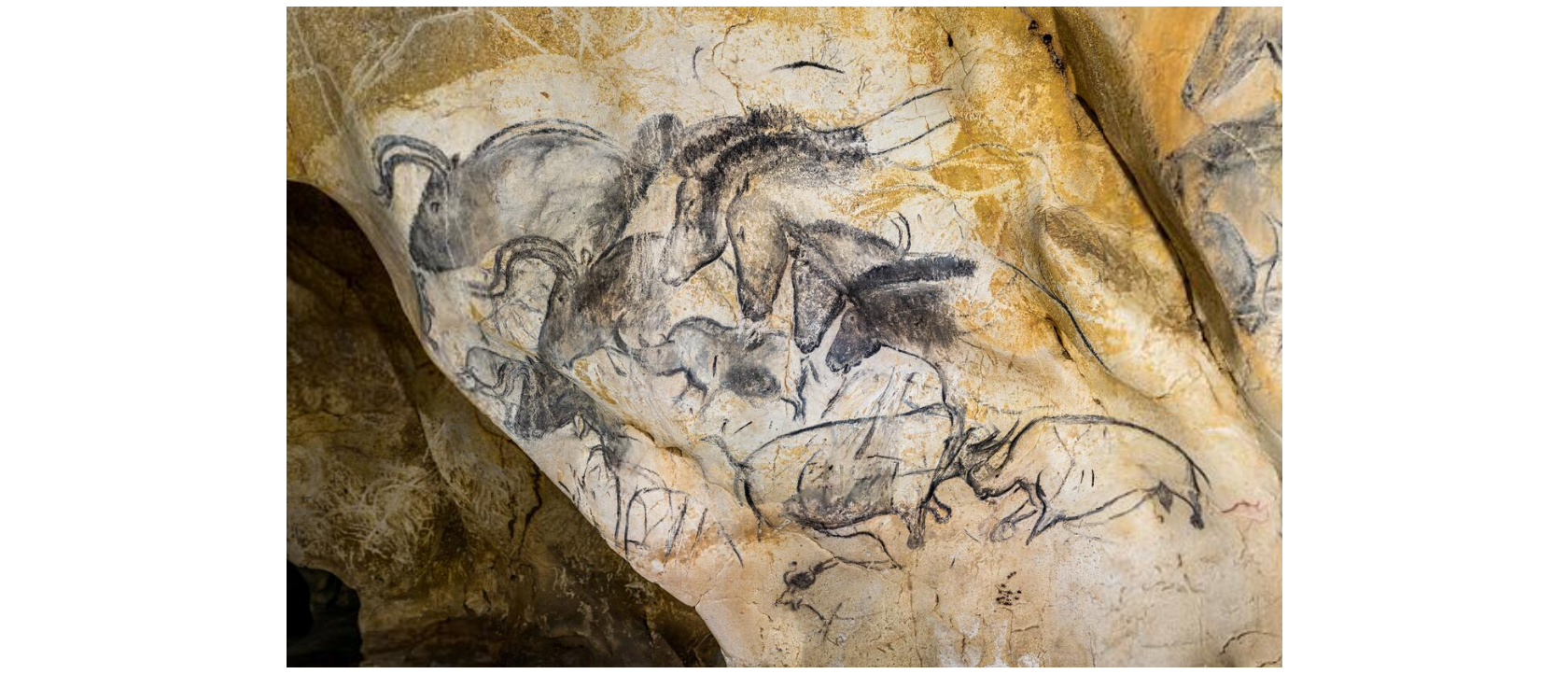
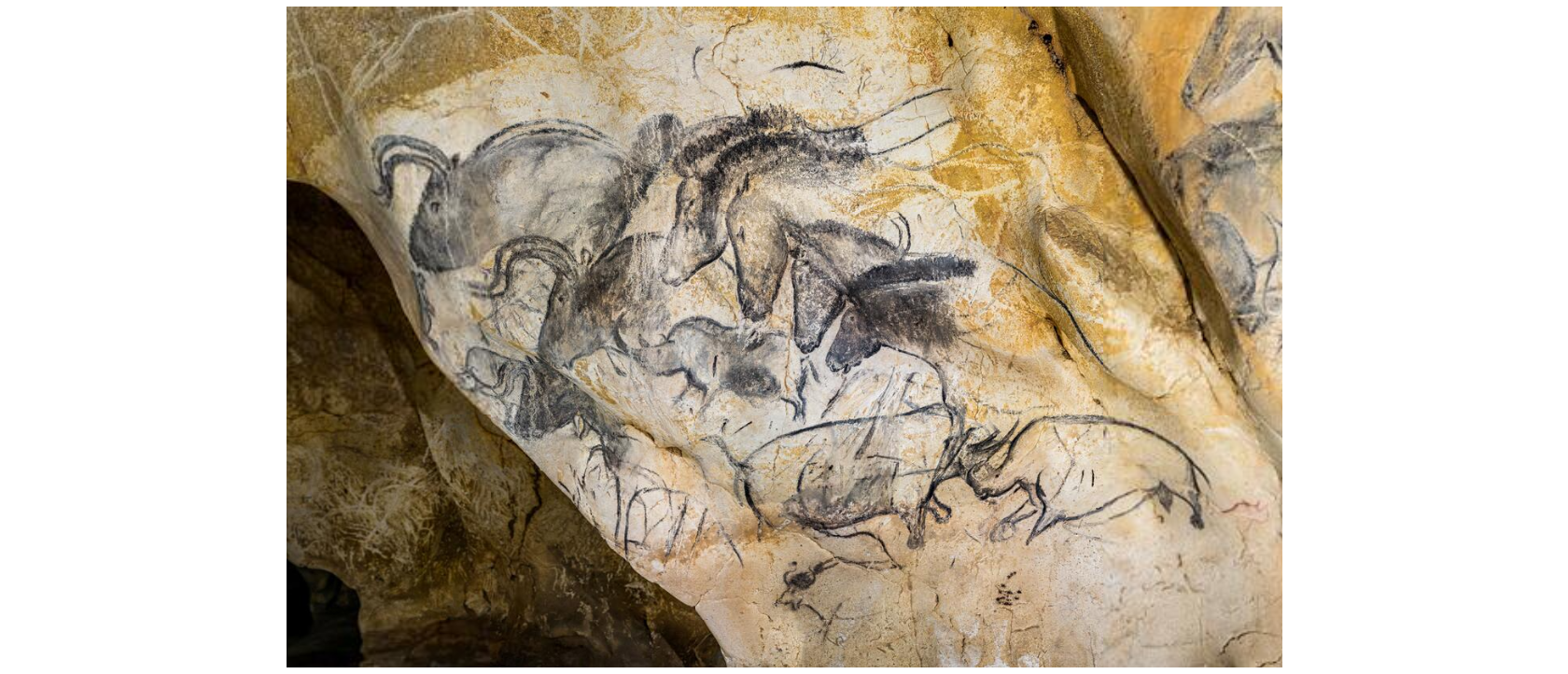
Horses Panel, Chauvet-Pont d’Arc Cave
As I moved on to the readings on prehistoric art, this partnership of technology and creativity was reinforced by the study of the cave paintings of France and Spain. Paleolithic people created pigments from raw materials, utilized fire to illuminate their workspaces, and shaped stone with early tools. The art found in these caves are surprisingly complex and nuanced. Shading, perspective, and symbolism are used to great effect. The Chauvet cave is unique in that it shows the walls were scraped clean in preparation for the mural work. These early people were creating with intention, with purpose.
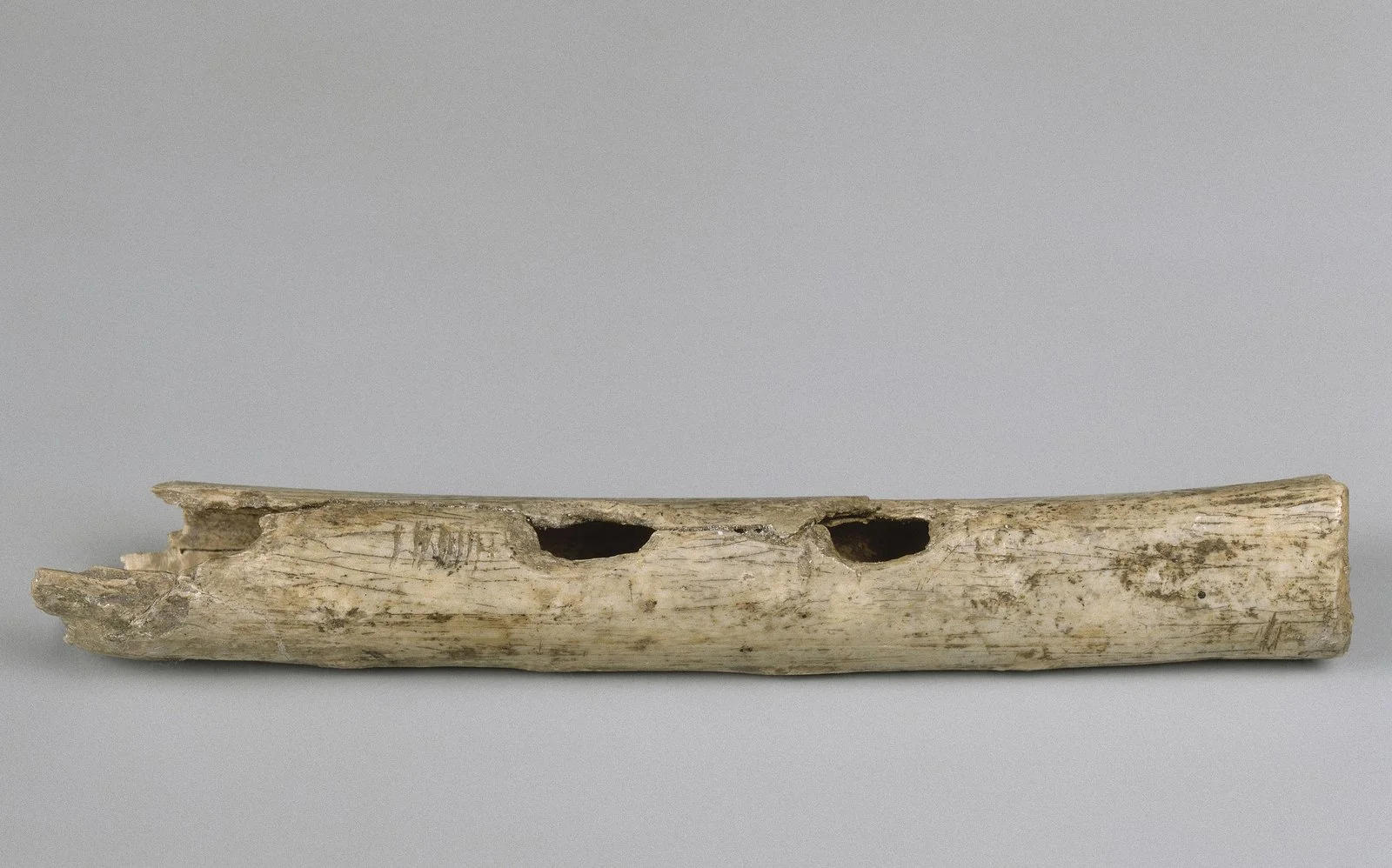
Bone flute
Isturitz Cave, Isturitz, Pyrénées-Atlantiques, MAN 77 142 - o: picture CE 1282
In addition to painting on cave walls, prehistoric peoples were also sculpting. Some artists used clay to add depth and dimension to the animal figures they painted. Developments in stone working also brought about more finely shaped works. Stone figurines like the Woman of Willendorf are some of the earliest examples of human representational art. These sculptures are almost exclusively women, which has led to many different interpretations of their purpose or meaning.
Paleolithic people left indications of the beginnings of what we would recognize as culture. Representational art in stone and clay stands the test of time. It is possible there were other, earlier artforms that have not survived - things made of wood or fiber. We know that music was another artform that early humans created. The human voice leaves no archeological trace, but musical instruments found in the painted caves provide proof of their musical traditions.
Around 10,000 BCE, humanity took a massive leap in technological innovation. We invented agriculture. Food surpluses allowed for the development of larger communities, eventually leading to the establishment of cities. With cities came advancements in architecture, systems of government, specialized work forces, and trade. Art boomed in the ancient Near East for many of these reasons.
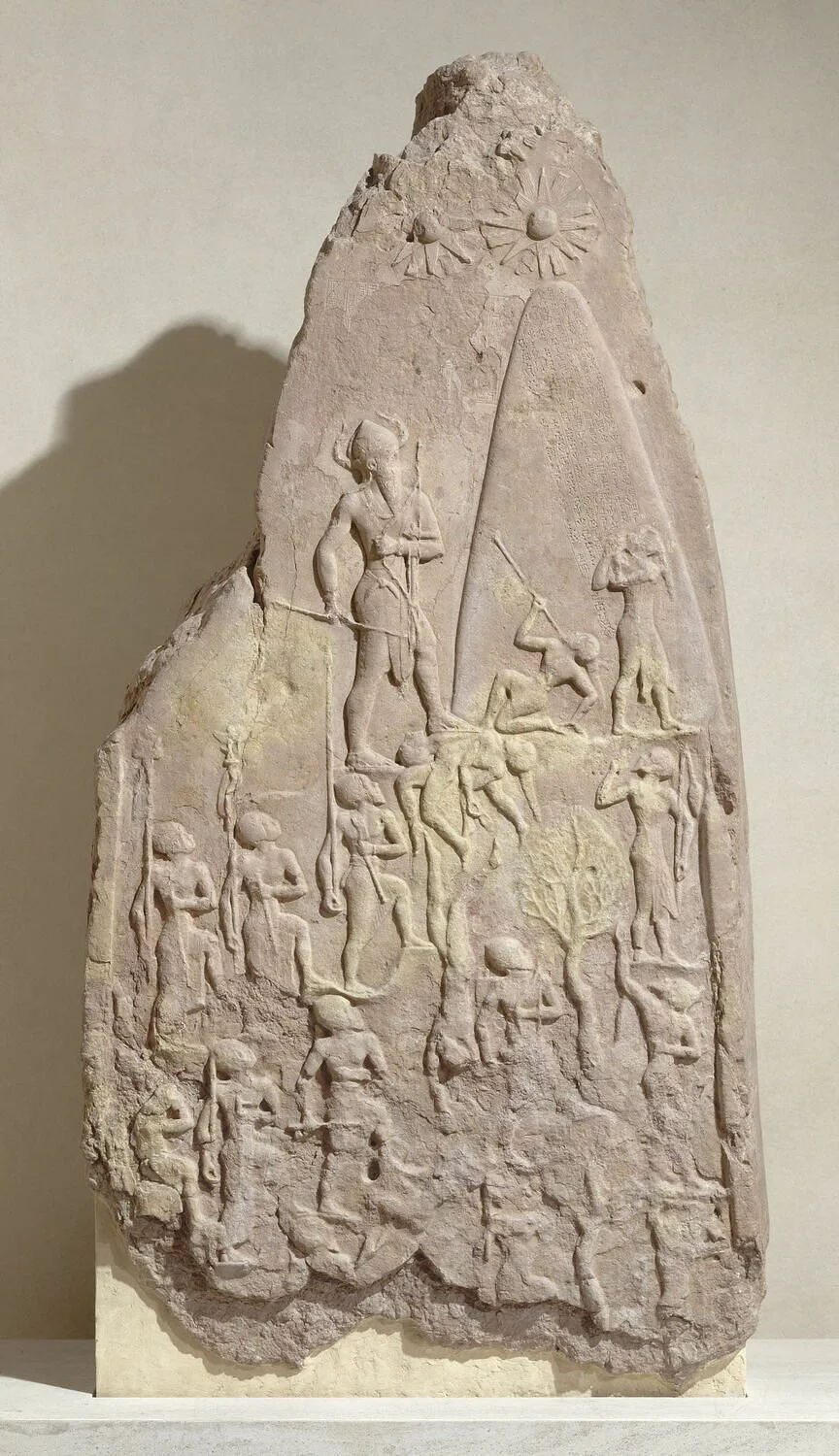
Victory Stele of Narām-Sîn, Musée du Louvre, Paris
Many cultures waxed and waned throughout Mesopotamia following the establishment of agriculture - the Sumerians, Assyrians, Babylonians, Akkadians, and Persians are just a few. Hierarchical community structures grew and the art of the period reflected this. The Stele of Naram-Sin is an example of art being used to both tell a story and reinforce these structures. It depicts the Akkadian ruler Naram-Sin in a position of leadership - bringing his army to battle and defeating his enemies. The use of hierarchic scale and symbolic attributes elevate Naram-Sin above the other people in the scene.
Sumerian city-states built their temples atop massive ziggurats. The growth of religion and the priesthood brought with it temple and devotional art. The Sumerians are also credited with the invention of written language in the form of clay tablets and wedge shaped styluses. Written language and bureaucratic growth led to the development of cylinder seals for official documentation. These seals were made of hard, sometimes semiprecious materials like lapis lazuli.
Some of the most widely recognizable Mesopotamian figures are the human-headed winged lions from the palace of Ashurnasirpal II in Nimrud. These lamassus were guardian figures carved in relief on the limestone and alabaster veneered walls of the palace. Additional panels of scenes depicting battles, hunts, and leisure activities filled the space.
The art of the Ancient Near East is varied and complex. Painting, sculpture, architecture, ceramics, and textiles all saw dramatic shifts and evolution in their design and technology in this period. Some themes that arose in the readings this week were the use of art to enforce cultural norms and societal structures, convey strength and masculinity/femininity, and the distinctness of one group of people from another.
Winter Quarter 2026 Syllabi
Art History 101 and Art Studio: Watercolor course syllabi for Winter Quarter 2026.
Art History 101
I created this syllabus by pulling from other syllabi, books, and websites including:
Introduction to the Visual Arts of the World, Instructor: Tobah Aukland-Peck, City College of New York
Art History Survey, Instructor: Agnieszka Ficek, Baruch College
Art: Its History and meaning, Instructor: Joseph Henry, Brooklyn College
arthistoryeachingresources.org
A History of the World in 100 Objects, BBC Radio Podcast
Overview
This course will cover art history world wide from prehistory to the Renaissance. Each week will focus on a region and/or time period. Readings will come from online articles and/or textbook chapters. Videos and podcasts will supplement the readings.
Assignments
Weekly written reviews of the topics covered in the course.
VIdeo diary consisting of weekly updates on the course as a whole and the personal curriculum project.
Final paper on one of the artworks covered in class.
Schedule
Week 1: Prehistory and Ancient Near East
Read: Emma Groeneveld, “Chauvet Cave,” Ancient History Encyclopedia, February 12, 2017, https://www.ancient.eu/Chauvet_Cave/
Watch: The British Museum, "The Jericho Skull," in Smarthistory, March 30, 2018, https://smarthistory.org/jerichoskull/.
Read: https://www.nytimes.com/2017/07/05/nyregion/hobby-lobby-artifacts-smuggle-iraq.html
Read: https://www.metmuseum.org/essays/ur-the-ziggurat
Week 2: Ancient Egypt & Africa
Reading: Stokstad Chapter 3, Art of Ancient Egypt
Read: Timeline of Ancient Egypt: https://www.ancient-egyptonline.com/images/ancient-egypttimeline.png
Read: Dr. Amy Calvert, "The Great Pyramids of Giza," in Smarthistory, August 8, 2015, https://smarthistory.org/the-great-pyramids-of-giza/.
Listen: “Rosetta Stone,” A History of the World in 100 Objects, BBC Radio Podcast
Reading: Stokstad Chapter 16, African Art
Read: Erin Blakemore, “73,000-Year Old Doodle May be World’s Oldest Drawing,” National Geographic https://www.nationalgeographic.com/science/article/news-ancient-humans-art-hashtag-ochre-south-africa-archaeology
Read: Natalie Hager, “Apollo 11 Stones,” Khan Academy https://www.khanacademy.org/humanities/ap-art-history/global-prehistoryap/paleolithic-mesolithic-neolithicapah/a/apollo-11-stones-2
Watch: “The Rosetta Stone of San Bushman Rock Art,”https://www.youtube.com/watch?v=7ll1A8nXCss
Watch: “Lost History: the terracotta sculpture of Djenne Djenno,” Smart History https://smarthistory.org/lost-historythe-terracotta-sculpture-of-djennedjenno-2/
Watch: Dr. Beth Harris and Dr. Steven Zucker, "How to do visual (formal) analysis," in Smarthistory, September 18, 2017, https://smarthistory.org/visualanalysis/.
Week 3: OFF WEEK - Family Vacation
Week 4: Ancient Greece & Rome
Reading: Stokstad Chapter 5, Art of Ancient Greece
Read: Colette Hemingway, “Architecture in classical Greece”, Heilbrunn Timeline, http://www.metmuseum.org/toah/hd/grarc/hd_grarc.htm
Watch: Dr. Steven Zucker and Dr. Beth Harris, "Contrapposto explained," in Smarthistory, December 16, 2015, https://smarthistory.org/contrapposto/
Optional reading on the origins of the Olympic Games: The British Museum, "Olympic games," in Smarthistory, August 29, 2016 https://smarthistory.org/olympicgames/.
Read: https://www.theguardian.com/commentisfree/2017/apr/04/brexit-deal-parthenon-marbles
Reading: Stokstad Chapter 6, Etruscan and Roman Art
Watch: The Pantheon, Smart History https://smarthistory.org/the-pantheon/
Watch: Rome’s History in four faces at the Met, https://www.khanacademy.org/humaniies/ancient-artcivilizations/roman/beginners-guiderome/v/romes-history-in-four-faces-atthe-met?modal=1
Week 5: Byzantine, Early Christian, and Jewish Art
Reading: Stokstad Chapter 7, Jewish, Early Christian and Byzantine Art
Read: https://www.metmuseum.org/essays/jewish-art-in-late-antiquity-and-early-byzantium
Read: https://www.metmuseum.org/essays/icons-and-iconoclasm-in-byzantium
Watch: Dr. Ronnie Perelis and Dr. Steven Zucker, "Book of Morals of Philosophers," in Smarthistory, July 13, 2017 https://smarthistory.org/book-ofmorals/.
Watch: “What is the Dome of the Rock?” Religion for Breakfast, Youtube, 2018 https://www.youtube.com/watch?v=FCXjQHFQF14
Read: Sarah Brooks, “Icons and Iconoclasm in Byzantium,” Heilbrunn Timeline, https://www.metmuseum.org/toah/hd/icon/hd_icon.htm
Watch: Dr. William Allen, "Hagia Sophia, Istanbul," in Smarthistory, August 8, 2015, https://smarthistory.org/hagiasophia-istanbul/
Watch: “Making Manuscripts,” Getty Museum, Youtube, June 17. 2014, https://www.youtube.com/watch?v=nuNfdHNTv9o
Week 6: Islamic Art
Reading: Stokstad Chapter 8, Islamic Art
Read: https://www.metmuseum.org/essays/calligraphy-in-islamic-art
Read: https://www.metmuseum.org/essays/figural-representation-in-islamic-art
Read:https://www.metmuseum.org/essays/geometric-patterns-in-islamic-art
Week 7: Art of Meso and South America
Reading: Stokstad Chapter 15, Art of the Americas
Listen: Neil MacGregor, “Olmec Stone Mask,” A History of the World in 100 Objects, BBC Radio Podcast, https://player.fm/series/a-history-ofthe-world-in-100-objects/olmec-stonemask
Read: James Doyle, “Olmec Art,” Heilbrunn Timeline of Art history, The Met, February 2017 https://www.metmuseum.org/toah/hd/olmc/hd_olmc.htm
Read: James Doyle, “Ancient Maya Sculpture,” Heilbrunn Timeline of Art history, The Met, April 2016, https://www.metmuseum.org/toah/hd/mayas/hd_mayas.htm
Read: Dr. Lauren Kilroy-Ewbank, "Introduction to the Aztecs (Mexica),"in Smarthistory, March 19, 2018, https://smarthistory.org/introduction-mexica/
Listen: Neil MacGregor, “Inca Gold Llama,” A History of the World in 100 Objects, BBC Radio Podcast
Read: Daniel Cossins, “We thought the Incas couldn't write. These knots change everything,” NewScientist, 26 November, 2018, https://www.newscientist.com/article/mg23931972-600-we-thought-theincas-couldnt-write-these-knotschange-everything/#ixzz6VVYkNnvk
Read: https://www.metmuseum.org/essays/gold-of-the-indies
Week 8: Native American/First Nations Art
Read: Dr. Lauren Kilroy-Ewbank, "Mesa Verde," in Smarthistory, August 9, 2015, https://smarthistory.org/mesaverde-cliff-dwellings/
Read: Dr. Katherine T. Brown, "Fort Ancient Culture: Great Serpent Mound," in Smarthistory, August 9, 2015, https://smarthistory.org/fortancient-culture-great-serpentmound/
Read: https://www.burkemuseum.org/news/origin-seahawks-logo-story-unfolds
Week 9: Asian Art
Read: Melody Rod-Ari, “Hinduism and Buddhism: An Introduction, ”Smart History https://smarthistory.org/hinduism-andbuddhism-an-introduction/
Read: Pringle, Heather, “Ears of Ancient Chinese Terra-Cotta Warriors Offer Clues to Their Creation,” National Geographic (November 14, 2014) https://www.nationalgeographic.com/news/2014/11/141114-terra-cottawarriors-qin-shi-huang-tomb-chinaarchaeology/
Read: Maxwell Hearn, “Chinese Painting,” Hellibrun Timeline of Art History, The Met https://www.metmuseum.org/toah/hd/chin/hd_chin.htm
Read: https://smarthistory.org/night-attack-on-the-sanjo-palace/
Read:https://www.nytimes.com/2004/02/03/arts/after-the-nightmare-saving-cambodia-s-treasures.html Reading: Stokstad Chapter 9, Later Asian Art
Week 10: Medieval Europe and Early Renaissance
Reading: Stokstad Chapter 10, Early Medieval and Romanesque Art
Read: The Guerrilla Girls “Chapter 2: Hot Flashes from the Middle Ages
Watch: BBC One, "The Bayeux Tapestry, from BBC," in Smarthistory, December 21, 2015, https://smarthistory.org/the-bayeuxtapestry-from-bbc-ones-seven-agesof-britain/ Read: Anika Burgess, “The Strange and Grotesque Doodles in the Margins of Medieval Books,” Atlas Obscura, May 9, 2017, https://www.atlasobscura.com/articles/medieval-marginalia-books-doodles Reading: Stokstad Chapter 11, Gothic Art
https://arthistoryteachingresources.org/lessons/early-medieval-art/
Reading: Stokstad Chapter 12, Early Renaissance Art
Art Studio: Watercolor
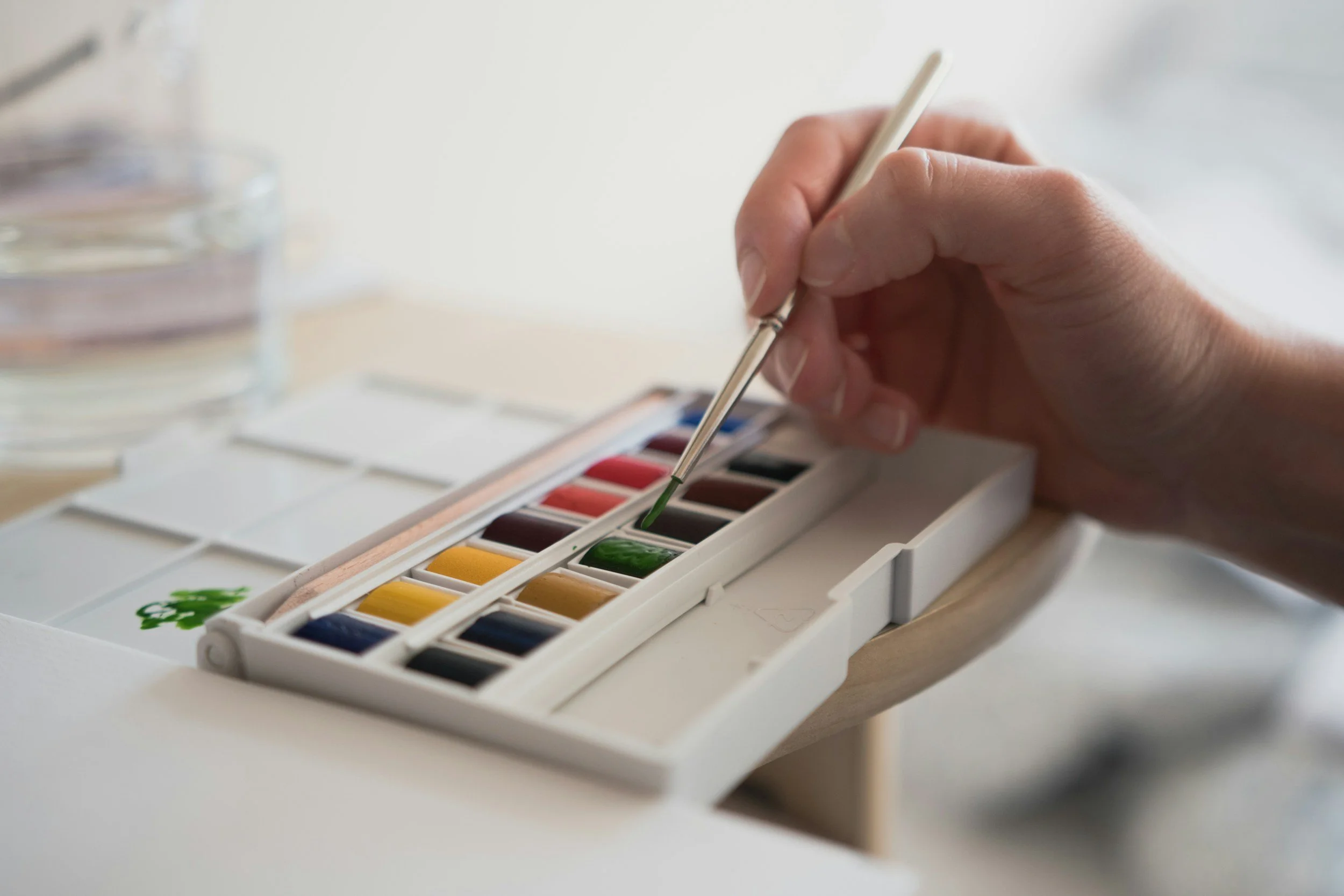

This course was developed primarily from the book “Everyday Watercolor” by Jenna Rainey. Videos and online tutorials will supplement.
Overview
This studio course is designed to introduce basic concepts related to watercolor and develop skills in various watercolor techniques. Each week will have one or more new skills to practice.
Assignments
Weekly watercolor practice with skills covered in class
Video diary consisting of weekly updates on the course and the personal curriculum project.
Final painting implementing at least 5 of the techniques covered in class.
Schedule
Week 1: Technique
Section 1 of “Everyday Watercolor”
Watch: https://youtu.be/Ls620E6YhjI?si=o9O-n2NmrL4U10Ws
Watch: https://youtu.be/kXqaSriD9EQ?si=vcswEE5xvpeCzHU7
Week 2: Form and Perspective
Pages 56 - 65 of “Everyday Watercolor”
Watch: https://youtu.be/fPI3y7MnLpw?si=l9AlnrqXIR6clw17
Watch: https://youtu.be/vCzvnsl0IEk?si=aeI5ghEYWclYSKSf
Week 3: OFF WEEK - Family Vacation
Week 4: Light and Shadow
Pages 66 - 89 of “Everyday Watercolor”
Week 5: Complex Shapes and Forms
Section 3 of “Everyday Watercolor”
Week 6: Value, Volume, and Depth
Section 4 of “Everyday Watercolor”
Week 7: Application
Wide Landscape: Desert in “Everyday Watercolor”
Week 8: Application
Wide Landscape: Jungle in “Everyday Watercolor”
Week 9: Application
Final Desert Piece in “Everyday Watercolor”
Week 10: Application
Final Jungle Piece in “Everyday Watercolor”